Development process and quality
How is software built from preparation through release while remaining technically reliable? A project only stays predictable when rhythm, communication lines, and responsibilities are clear. Quality therefore has to be woven into day-to-day development: static analysis, reviews, tests, release management, and monitoring run through the whole of the work.

Who does what
Direct contact
We do not feel the need for heavy project layers or separate management roles. Engineers handle multiple duties: design and implementation, DevOps, hosting, Glossary · In briefmonitoringMonitoring systematically tracks software, infrastructure or processes through measurements and checks. Deviations can trigger alerts so an administrator can investigate.Read more, and Glossary · In briefquality assuranceQuality assurance (QA) is the set of planned, systematic measures a team uses to help software meet agreed quality requirements.Read more, without barriers between those areas. The client always has direct contact with the engineer or engineers working on the system.
That does not mean things stay vague. We clearly outline who on the client side sets priorities and handles acceptance, and who on our side decides on planning, technology, or operational choices. We simply avoid adding bureaucratic slowness through layers that are not necessary.
We develop in short cycles of building, testing, and adjusting. Direct communication lets us incorporate feedback into the next cycle.

Our approach
Quality must be visible early
Waiting until the acceptance or production environment to hit errors is unnecessarily risky, and it is simply expensive. We therefore try to catch problems as early as possible: in the editor, in the pipeline, through tests, and in environments that validate each Glossary · In briefreleaseA release is an identifiable software version prepared to be made available to users. It brings together one or more checked changes.Read more step.
These checks help make software more reliable. When you see errors, vague assumptions, or security issues early, they are far less likely to pile up into costly surprises.

Explore each topic
From collaboration to controlled delivery
Agile collaboration keeps priorities, feedback, and decision-making close to execution, so a project stays adaptable without becoming directionless.
The sprint rhythm makes work more concrete, keeps progress visible, and prevents deviations from becoming discussable only at the very end.
Building interfaces from reusable components makes front-end work more consistent, faster, and easier to review, especially when multiple people work on it in parallel.
Separated environments and clear release moments reduce the risk of changes reaching production unexpectedly.
Reviews keep changes small, discussable, and explainable. That helps you spot risks, unclear assumptions, and maintenance issues before code is merged.
Static analysis, type safety, and targeted tests define what must keep working as the codebase changes. That makes regressions visible much earlier.
Automatic checks return feedback quickly on every change, so integration stays small and problems show up early.
Versions, changelogs, environment validation, and monitoring keep releases traceable, manageable, and easier to explain to both team and client.
Short iterations, short lines
Agile collaboration
Agile collaboration keeps priorities, feedback, and decision-making close to execution, so a project stays adaptable without becoming directionless.
Different steps
The rhythm of building together
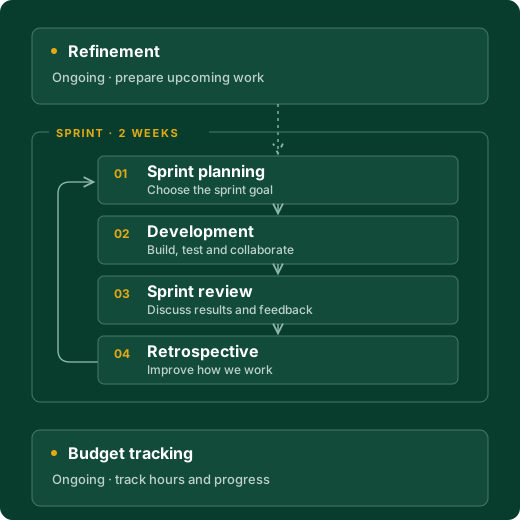
Every Glossary · In briefsprintA sprint is a short, fixed period in which a team develops an agreed part of the software. Afterwards, you review the result and decide on the next priorities.Read more follows the same steps. That fixed rhythm makes sure Glossary · In briefscopeScope defines the boundaries of a project or assignment: which goals, activities and results are included and which are excluded.Read more, delivery, budget, and process come up at agreed moments, instead of only when someone raises a flag.
Refinement Throughout the sprint, we refine functionality, scope, and acceptance criteria. Tickets become more concrete and hidden assumptions become visible early.
Sprint planning Per sprint we decide which functionality has priority and what realistically fits in the coming iteration.
Execution Engineers focus on the chosen goals, with discussion on substance when that is truly needed.
Sprint review Stakeholders review what was delivered and what that means for the next priorities.
Budget tracking Throughout the sprint, we make visible how progress relates to the estimate. Where course correction can help, we bring that up too.
Retrospective We look back at the process itself. What worked well, what slowed things down, and what can we do differently in the next sprint?
From code to production
Architecture, security, and releases must move together
Quality goes beyond testing alone.
We do not separate architecture decisions from operations, security, or where the system needs to be in two years. We prefer patterns and technologies that remain maintainable, check code and Glossary · In briefdependencyA dependency is a software component or system that other software needs in order to build or run, such as a library, framework or external service.Read more for known risks, and move releases through separate environments in a controlled way.
Once a release is live, you also need to know whether the application behaves as expected in practice. We monitor errors, performance problems, and anomalies. Together with release management and Glossary · In briefOTAPOTAP is the Dutch abbreviation for Development, Test, Acceptance, and Production. These are separate environments for building, testing, reviewing, and using software.Read more validation, that creates a process in which changes reach production in a controlled way.

What this gives you
A fixed development rhythm with clear meeting moments
Engineers with broad responsibility, without unnecessary middle layers
Fewer regressions with new functionality
More grip on releases and environments
A process in which knowledge, choices, and reviews stay traceable
Frequently asked questions
We work in two-week sprints. Not everything happens exactly on that sprint boundary, of course, but priorities and progress do come to the table in a fixed rhythm.
No. The goal is not to expand the paperwork or add yet another checklist to an already full sprint. We want more reliability with as many automated checks as possible.
What this looks like in detail depends on the system and its risks. The goal is always the same: show that critical business logic and important flows are protected. In practice that usually means a mix of static analysis, unit tests, integration tests, and where needed end-to-end checks.
Absolutely. Watching errors, performance, and other signals is an essential part of software you want to keep under control after release. Read more about maintenance and support.
Is your question not listed here?
Get in touch