From prototype to sellable product
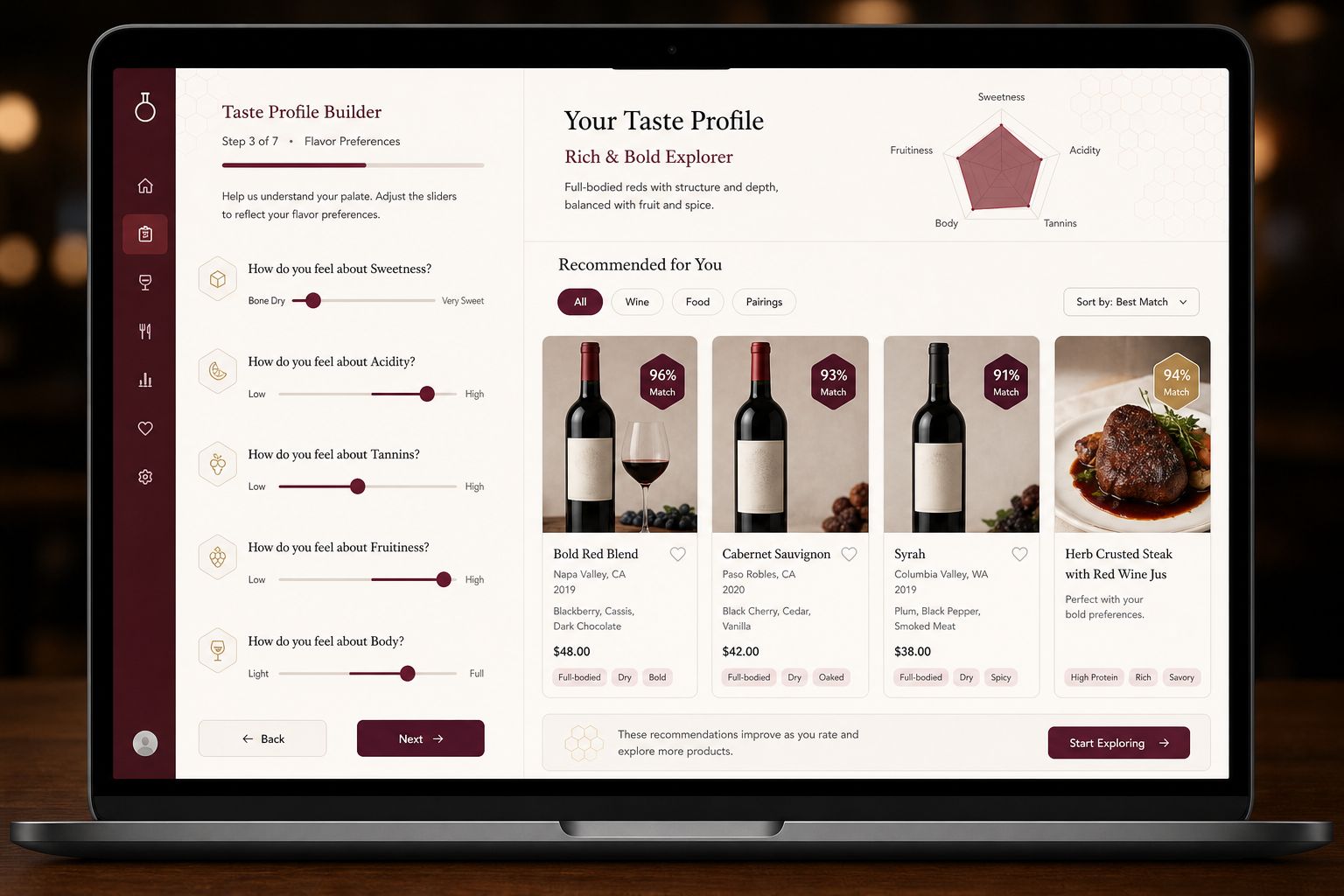
TasteIndex designed a test that maps taste profiles, but had no development team to turn that into a scalable software product. We built a configurable platform with score-based advice, white-label branding, and administration — usable in demos and in production.

- Industry
- E-commerce
- Location
- Rotterdam
Team

TasteIndex devised a test that reveals the taste profile of end users. Wine and food webshops turn that knowledge into tailored product advice. Whether it works depends mainly on one thing: if the recommendation is on target, you see it back in conversion and repeat purchases.
The situation
A good idea without own development capacity
They had a working Glossary · In briefprototypeA prototype is an early, simplified version of a product. It makes an idea visible or testable so you can learn before developing the complete product.Read more and a strong substantive vision. But the team that could rebuild this into a Glossary · In briefweb applicationA web application is a program you use through a web browser to complete tasks or process data. Processing can take place partly in the browser and partly on a server.Read more that customers place in their own webshop was still missing.
We needed to adapt the prototype for different webshops, regional cultures, and taste profiles. TasteIndex also wanted to demonstrate the platform to potential customers.
The question behind the question
Further than one taste profile
The first design showed the broad lines. What was missing were targeted product choices to raise commercial value. Not a simple questionnaire, but a configurable platform that scales as the customer base grows.
Hence the step to a score-based model: end users get a ranked list from best fit to least fit, so everyone sees the full assortment and the webshop can give more usable advice.
In addition the questionnaire had to be configurable per customer and region. Taste and expectation differ per market, think of the same product category in the Netherlands versus Belgium. And every webshop must be able to run its own branding, including demo environments in a prospect's house style.
Approach
From a loose test to a configurable platform
We built a system in which the original questionnaire was developed into a score-based model. The platform calculates weighted matches and assigns a rank, instead of landing end users on a single taste profile.
We also made the questionnaire configurable per customer and region. And we built the application so customers can run their own branding, including demo environments in their own house style.
What we add
A sellable product The platform became suitable for both end users and sales demos toward new customers.
Configuration per customer Questionnaires, branding, and product logic can be adjusted per webshop or market.
Grip on administration and insights With an admin system and Metabase statistics TasteIndex got control over content, products, and usage data.
More than a questionnaire
The value of the system sits not only in the outcome of the test, but also in the room to develop the product further. That is why we built functionality to remember personal scores, build profiles, and include additional questions, such as budget for a purchase.
For administration we developed an admin system with which TasteIndex can steer content, products, and questionnaires independently. We also made statistics available via Metabase, so customers can better see how end users move through the system.
Result
A platform that helps convince new customers
The platform gives existing customers personalized product advice. TasteIndex can show potential customers a working demo in their own branding.
TasteIndex now has working software plus a solid foundation they can continue building on independently. Extensions to the questionnaire are still ongoing: saving scores, building profiles, and adding extra questions.
It is the first time I experience software development as simple, transparent, and measurable.
Viktor Mirovic — Eigenaar bij TasteIndex
Key takeaways
A substantively good prototype can be productized if you take score-based logic, configuration per market, and white-label branding along from day one.
Demo environments in a prospect's house style make an abstract idea concrete, crucial in B2B sales of embedded software.
Via admin and Metabase the customer keeps grip on content and usage behavior, without needing development for every change.
The trajectory continues: personal scores, profile building, and additional questions form the next step.
OUR WORK